Love in Morse Code: Meaning, Code Breakdown, and Uses


Some words carry weight no matter how you say them. "Love" is one of those. Say it out loud, write it in a letter, or tap it on a table in dots and dashes. It still lands.
Morse code turns "love" into a pattern you can hear, see, and touch. Four letters. Seventeen signals total. Short enough to memorise in a few minutes. Meaningful enough to use for the rest of your life. Let's break it down.
How to Write "Love" in Morse Code
Here's the full pattern for the word "love" in International Morse code. Each letter separated by a space. When you send it, you don't pause between the dots and dashes within a letter. The space between letters is where the pause lives.
| Letter | Morse Code | Sounds Like |
|---|---|---|
| L | ·−·· | dit-dah-dit-dit |
| O | −−− | dah-dah-dah |
| V | ···− | dit-dit-dit-dah |
| E | · | dit |
When you put them all together, the Morse code for love looks like this:
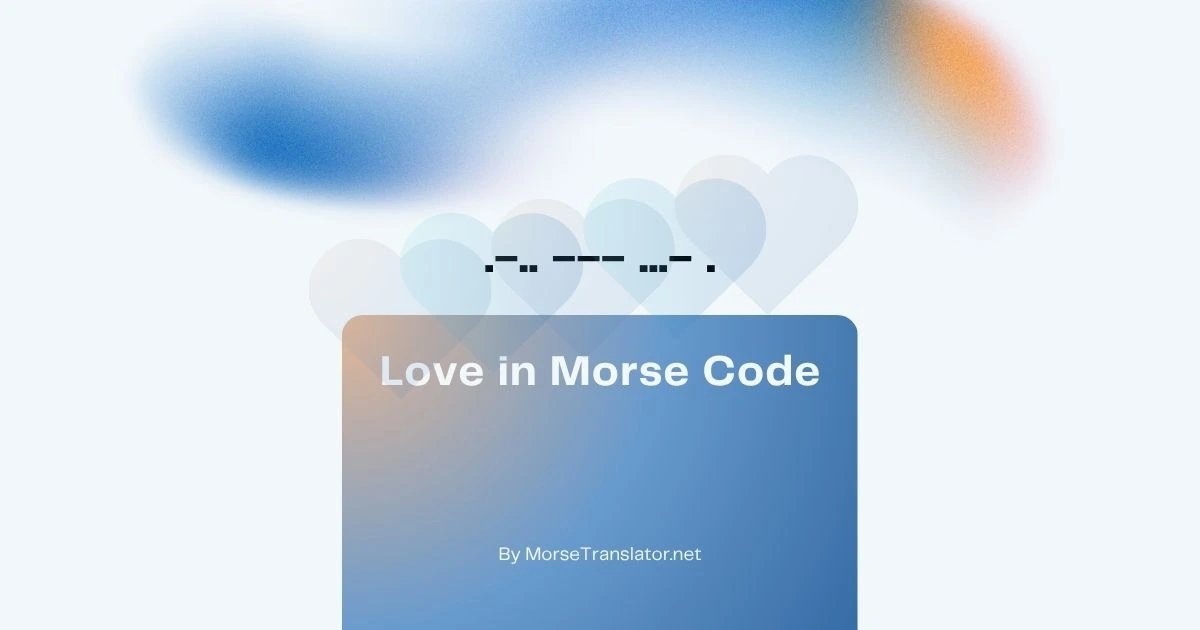
.-.. --- ...- .
Altogether: dit-dah-dit-dit dah-dah-dah dit-dit-dit-dah dit
That's it. Seventeen quick signals. Once you hear the rhythm a few times, it sticks. If you ever need to double-check a character, you can refer to the Morse code alphabet chart.
Why the Pattern Works
"Love" is a satisfying word to learn in Morse for a few reasons. It has variety: L starts with a dot, O is all dashes, V ends with a dash, and E is a single dot. Your ear gets a mix of short and long sounds. That makes it easier to remember than a word that's all dots or all dashes.
The rhythm of the word also influences how people remember it. Studies on pattern recognition suggest the brain latches onto varied sequences faster than uniform ones (Wikipedia). "Love" gives you exactly that: a bounce, a hold, a lift, and a stop.
Letter-by-Letter Breakdown with Sound
Seeing each letter by itself makes the sequence easier to memorize and reproduce, especially if you plan to tap it out or say it aloud. Let's take them one at a time.
L – ·−·· (di-dah-di-dit)
L opens the word with a gentle bounce. It's a dot, then a dash, then two dots. Say it as "di-dah-di-dit" and notice how the dash gives it a little stretch in the middle.
O – −−− (dah-dah-dah)
O is the heaviest letter here. Three long dashes in a row. It sounds like a held note, steady and unhurried. When you tap it, each dash lasts three times longer than a dot.
V – ···− (di-di-di-dah)
V picks up the pace again. Three quick dots followed by a dash. It lifts the rhythm right after O's weight.
E – · (dit)
E is the shortest possible signal in Morse code. A single dot, spoken as "dit." It closes the word with a quiet finality, like a soft breath at the end of a sentence.
When you flow them together (di-dah-di-dit dah-dah-dah di-di-di-dah dit) you'll hear the natural rhythm. It's not a random collection of beeps. It has shape. It almost feels like a heartbeat written in sound.
A Fun Example
Imagine you want to surprise your partner with a secret message. You could write .-.. --- ...- . on a small piece of paper and tuck it into their bag or leave it on their pillow. At first they might have no idea what those dots and dashes mean. But when they search online or use a Morse code translator, they'll realize it says "love." It's romantic, mysterious, and definitely unforgettable.
Some couples take it a step further. They use the code to create matching bracelets. The dots are represented by small beads, and the dashes by longer ones or tiny engraved lines. Every time you wear it, you're carrying a coded "love" with you. A quiet statement that only the two of you fully understand.
If you're planning to send longer messages or just want to get more comfortable with the patterns, our guide on how to learn Morse code fast walks you through simple daily drills that build real fluency.
Why Say "Love" in Morse Code?
There are many reasons people keep coming back to this little dot-dash pattern.
- It's unique and creative. Anyone can say "love," but encoding it shows effort and thought. It feels like a secret only the two of you share.
- It's timeless. Morse code has been around for nearly 200 years. Using it today connects your message to a long history of Morse code and the telegraph, yet it still feels fresh and modern.
- It's a symbol of connection. Each dot and dash is a small pulse. In a way, Morse turns the word "love" into a rhythm you can feel, almost like a heartbeat.
- It can be used anywhere. You don't need a phone or a pen. You can tap it on a table, blink it with a light, or hum it as short and long sounds. It's love beyond words.
"Love" vs "I Love You": What's the Difference?
People often search for "love in Morse code" wanting the full phrase. Here's the distinction:
| What You Want | Morse Code | Signal Count |
|---|---|---|
| Love (single word) | ·−·· −−− ···− · | 17 signals |
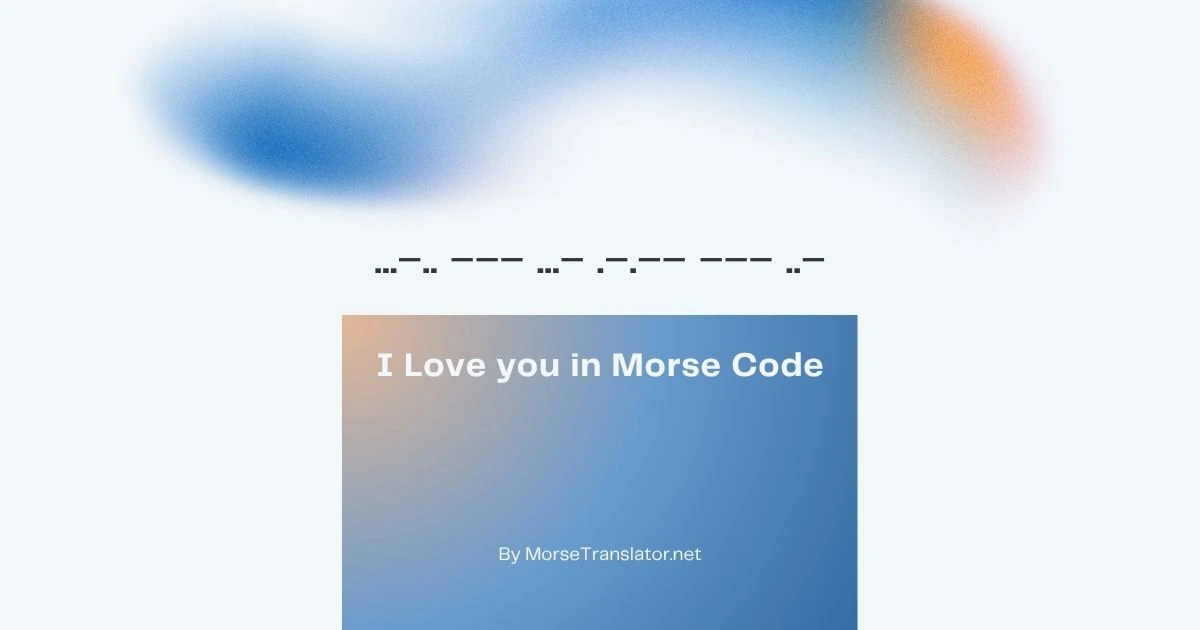
| I Love You (full phrase) | ·· / ·−·· −−− ···− · / −·−− −−− ··− | 34 signals |
The single word "love" is half the length. It's easier to tap, faster to flash, and simpler to fit on a bracelet or ring. If you want the full phrase, we have a dedicated guide on I love you in Morse code. But "love" on its own works beautifully for gifts, jewellery, and quick signals.
Love-Related Codes You Should Know
Morse operators don't always spell out every word. They use shortcuts. Here are the ones connected to love.
88 – Love and Kisses
In ham radio, 88 means "love and kisses." It's the affectionate version of 73 (best regards). In Morse: −−−·· −−−··. Operators typically send 88 to a spouse or romantic partner. It's been used since the early 1900s, back when telegraph operators chatted between messages and needed a polite shorthand for affection. The ARRL (American Radio Relay League) has archives documenting how these number codes became standard.
73 – Best Regards
Not romantic, but worth knowing: 73 means "best regards." It's the standard friendly sign-off. In Morse: −−··· ···−−. You'd use 73 with friends. 88 with someone you love. Easy distinction.
ILY – The Shortcut
ILY is the abbreviation for "I Love You." Three letters instead of eight. Much faster. In Morse: ·· ·−·· −·−−. That's: dit-dit / dit-dah-dit-dit / dah-dit-dah-dah. If you're tapping under a table or flashing a light, ILY cuts the time in half. Same message. Less effort.
143 – The Number Code
143 isn't Morse, but it pairs well with it. 1 letter in "I," 4 letters in "love," 3 letters in "you." People engrave 143 on jewellery or send it as a text. In Morse, 143 looks like: ·−−−− ····− ···−−. A lot of Morse bracelets use 143 instead of the full phrase because it's shorter and still decipherable.
How to Send "Love" Using Morse Code
Here are several creative ways to send "love" in real life.
- Using light. You can use a flashlight, your phone's torch, or even a candle. Flash a short light for a dot and a longer light for a dash. For instance, L would be short, long, short, short. Keep a steady rhythm and the message will be clear. For a full breakdown, read how to send Morse code with a flashlight.
- Using sound. Tap short and long beats on a table, a wall, or a musical instrument. Each short tap is a dot; each longer press or hold is a dash. The key is consistency: if your dashes all last three times longer than your dots, the message will read.
- Using text or gifts. Write
.-.. --- ...- .on a card, an envelope, a keychain, or a mug. It's subtle and quiet — the kind of detail that makes an ordinary object feel personal. - Digital messages. Send the code in a chat or email and add a hint like "decode this." Let them discover the message on their own. It's a tiny puzzle wrapped in affection.
- Through jewellery. This one's so popular it deserves its own section, which you'll find below. But the short version is: the pattern engraves beautifully on rings, necklaces, and bracelets.
Where the Pattern Works Best
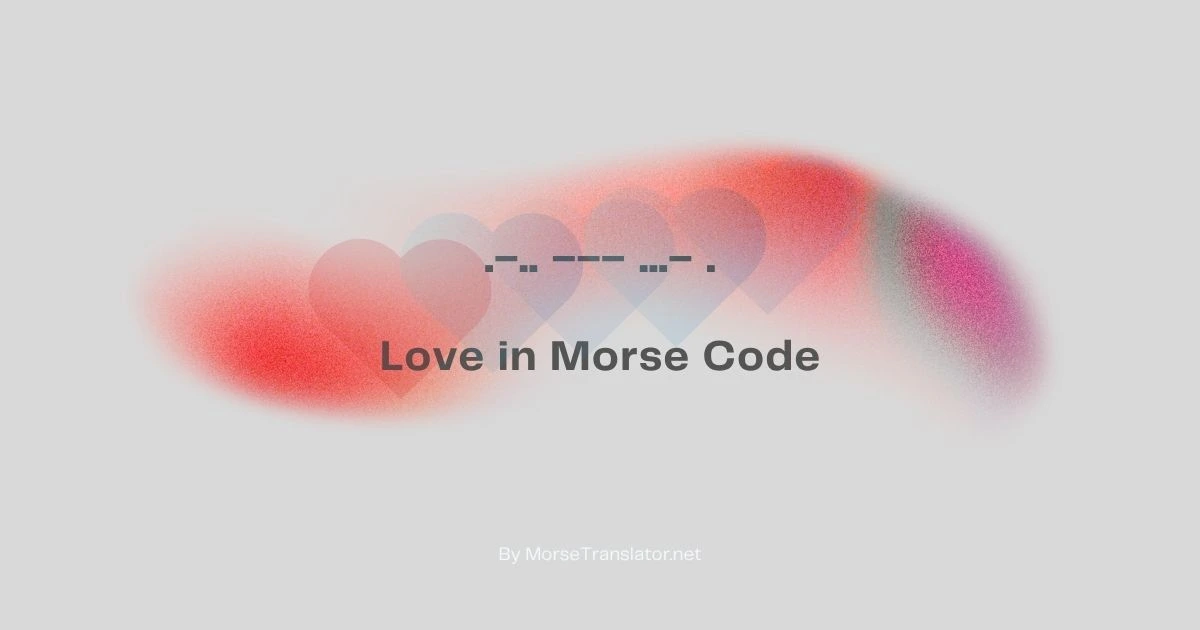
If you walk through any craft marketplace or browse online stores, you'll see Morse code designs popping up everywhere. The word "love" keeps appearing for good reason. It's short, visually balanced, and easy to engrave — which is why it's one of the most common uses in modern uses of Morse code.
Engraved Jewellery
Bracelets, necklaces, and rings engraved with .-.. --- ...- . carry the word close to the skin. The dot-dash pattern looks minimalist and elegant, and it works on almost any metal or leather. It doesn't demand attention, but when someone recognizes it, the connection is instant.
Home Decor
Framed prints, embroidered pillows, wall decals, even doormats — the coded word adds warmth without being loud. It fits into minimalist apartments, rustic farmhouses, and everything in between.
Personalized Gifts
Custom keychains, leather bracelets, engraved pens and wallet inserts — the pattern is small enough to fit almost anywhere but meaningful enough to turn a simple item into a kept memory.
Digital Messages and Social Media
Sending .-.. --- ...- . in a text or posting it as a status is a quiet gesture. It doesn't scream for attention. It just sits there, waiting for the right pair of eyes to notice.
Real-Life Examples of Morse Code in Love
Morse code isn't just a novelty. It has carried personal, heartfelt messages through some of history's most difficult chapters. During World War II, telegraph operators would sometimes slip brief personal notes between official transmissions: a quiet "love" tapped out across continents. In the middle of noise and urgency, those dots and dashes were a lifeline to someone far away.
A more recent story made the rounds a few years back: a man set up lights across his backyard and, one by one, flashed the word "love" and then "will you marry me." His partner had to decode the flashes before she understood what was happening. That's the quiet power of Morse. It turns an ordinary evening into something unforgettable.
These stories remind us that the message is never just about dots and dashes. It's about pausing long enough to say something important in a way that can't be scrolled past. The history of common Morse code words and phrases is full of such moments.
Quick Tips to Remember "Love" in Morse Code
If Morse feels tricky at first, don't worry. Here are a few easy ways to make it stick.
- Start with the rhythm, not the symbols. Listen to the sound first. Let your ears learn the flow before your eyes memorize the dots and dashes.
- Use a simple mnemonic. For L, think: "Let's start Long, then short-short-short." For O, imagine "Ohhh, three long dahs." For V, "Victory: dot-dot-dot DAH." And E is just "Easy dot." String them together and you have the whole word.
- Practise daily, even for five minutes. Use the sound buttons on this page. Consistency beats long study sessions every time.
- Mix methods. Tap it, whisper the "dit" and "dah" sounds, flash it with a light. Switching between modes cements the pattern in your memory.
- Challenge yourself. Try encoding other short words like "hope," "home," or a special nickname. Once you feel ready, the Morse code practice page gives you guided drills to build speed.
Expanding Beyond "Love"
Once you have this word down, other messages become easier. The same rhythm rules apply to every letter, number, and punctuation mark. If you want to explore the full set of characters, check out the Morse code numbers and punctuation guide.
And when you're ready for the phrase that deepens the message even further, see I Love You in Morse Code. It adds two more words and a whole new layer of meaning.
List of Common Morse Code Words & Translations
Here are a few essential translations to keep handy. They cover emergencies, help, and the longer phrase many people look for.
Each one opens the door to a different kind of message — from the universal call for aid to the quietest declaration of affection.
To sum up
The Morse code for love is not about hiding anything. It's about slowing someone down long enough to notice. Whether it's on a bracelet, in a flicker of light, tucked inside a note, or tapped quietly across a table, those dots and dashes say exactly what they need to.
Try it once. Send it to someone who matters. You'll understand why a handful of short and long signals can carry one of the biggest meanings there is.