Morse Code Prosigns & Abbreviations: Complete Guide


You're tapping out a message on your key. The rhythm feels good and the letters flow. Then you realize your friend on the other end is sending something that doesn't spell a word at all.
A few quick dits and dahs, a pause followed by another burst. And somehow, they've just said an entire sentence in half a second.
That's the magic of prosigns and abbreviations.
What looks like gibberish to an outsider is actually a fast, elegant shorthand. It's how experienced operators say more with less. It's the difference between writing a formal letter and sending a text that just says "LOL."
If you've ever wondered how radio operators pack so much meaning into so few signals, you're in the right place.
Let's explore the shortcuts that make Morse code sing.
Why Morse Code Shorthand Exists
Here's something that surprises most beginners.
Morse code isn't just about spelling words letter by letter. It never really was.
Back when telegraph lines first crisscrossed continents, operators sat for hours relaying messages. Every dot and dash took effort. Every letter burned time. And time? That was money.
So operators got clever.
They started condensing common phrases into tight little codes. "Thank you" became "TU." "Please" shrank to "PSE." Entire procedural signals got boiled down to single characters sent as one unit.
These aren't just casual shortcuts. Some of them are baked right into the history of radio communication.
When you're out camping and want to signal someone with a flashlight, knowing just a few prosigns changes everything. Instead of spelling out "error, let me start again," you just send a quick pattern and everyone understands.
That's the heartbeat of Morse code. Efficiency without losing the human touch.
What Are Prosigns, Exactly?
Prosigns are two or more letters sent together as a single character. You don't pause between the letters the way you normally would. They merge and become one new symbol with its own meaning.
Think of it like a contraction in English. "Do not" becomes "don't." The letters run together. Same idea here, just with sound.
The name "prosign" comes from "procedural signal." These are the operating instructions that keep radio communication organized. Things like "over to you" or "message received."
Abbreviations, on the other hand, are just shortened words. You still send the individual letters with normal spacing. "BTW" instead of "by the way." "GM" for "good morning."
Both save time. Both are worth learning. But prosigns are the deeper layer of the language.
The Most Important Prosigns You'll Actually Use
Let's get practical. Here are the prosigns that show up in real communication, whether you're on the radio or just having fun with a friend.
The Big Four
These are the ones every operator knows.
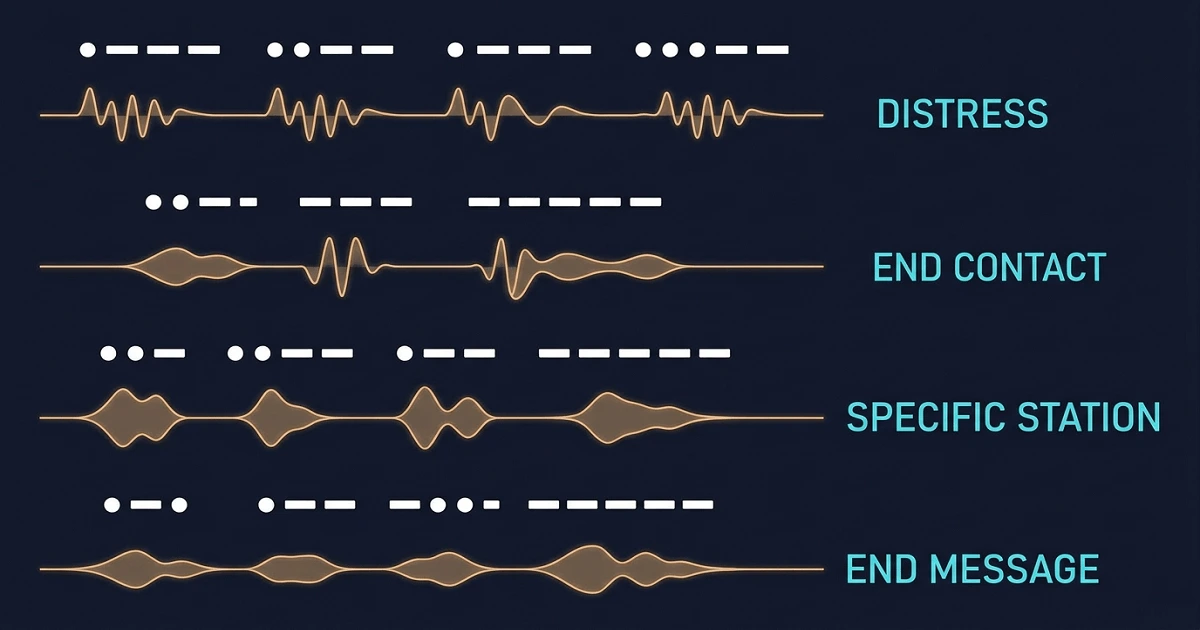
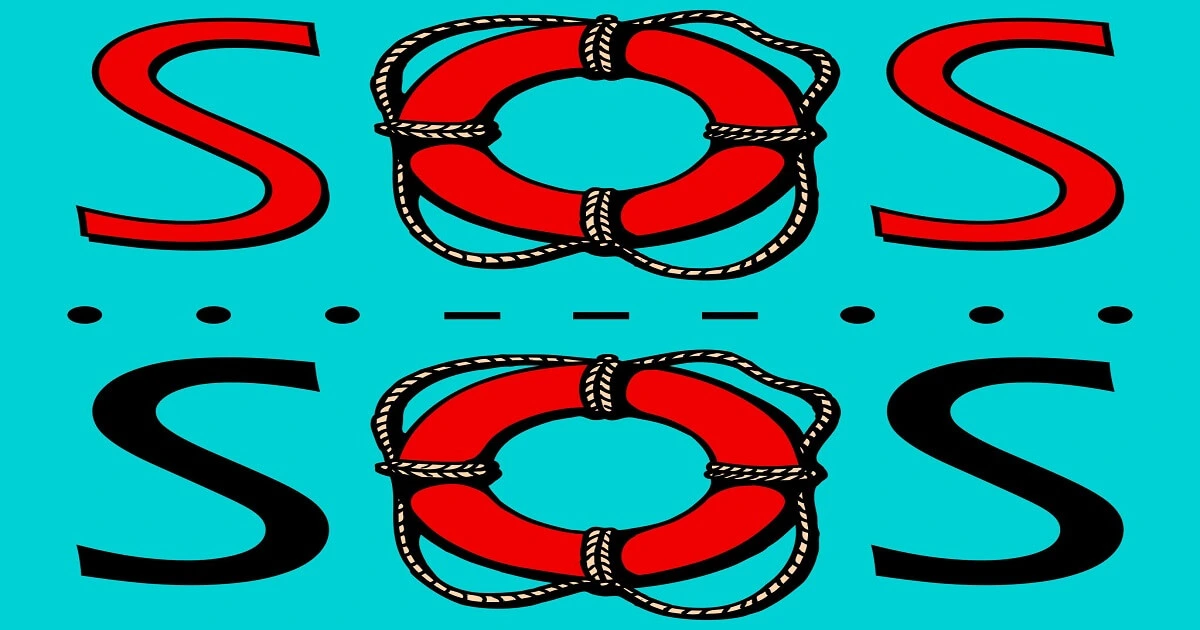
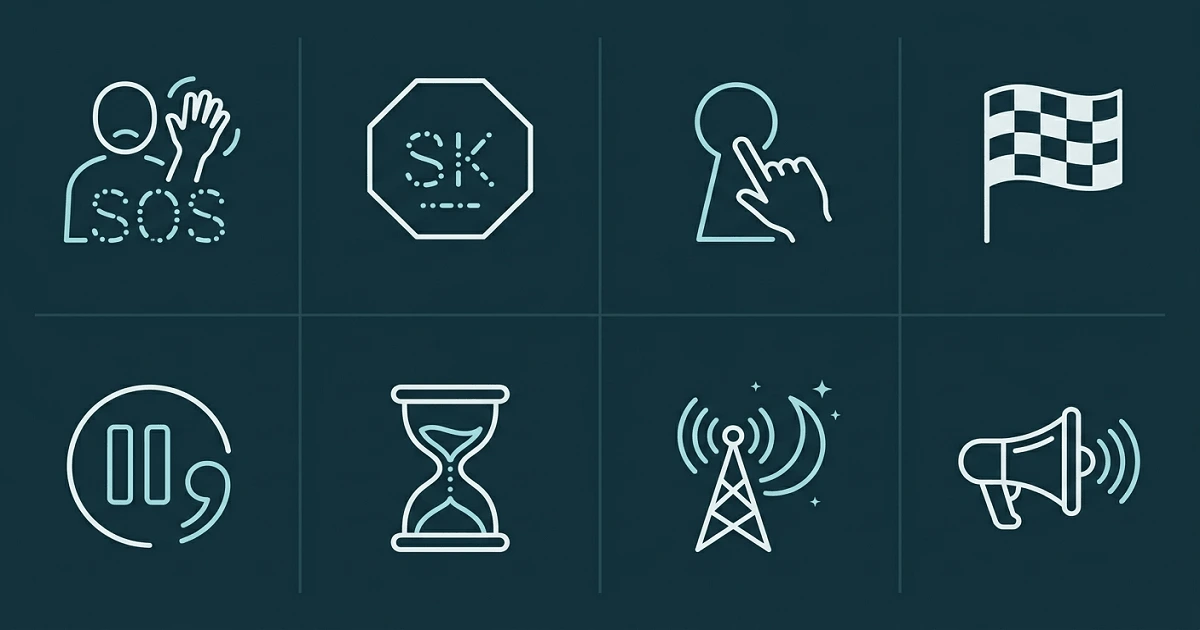
SOS - The universal distress signal. Three dots, three dashes, three dots. No spaces between letters. It's sent as one continuous string: dit-dit-dit dah-dah-dah dit-dit-dit.
Fun fact: SOS doesn't actually stand for anything. Not "Save Our Souls" or "Save Our Ship." Those came later. It was chosen because the pattern is simple, unmistakable, and easy to send even in terrible conditions. You can read the whole story behind it on our SOS distress signal history page.
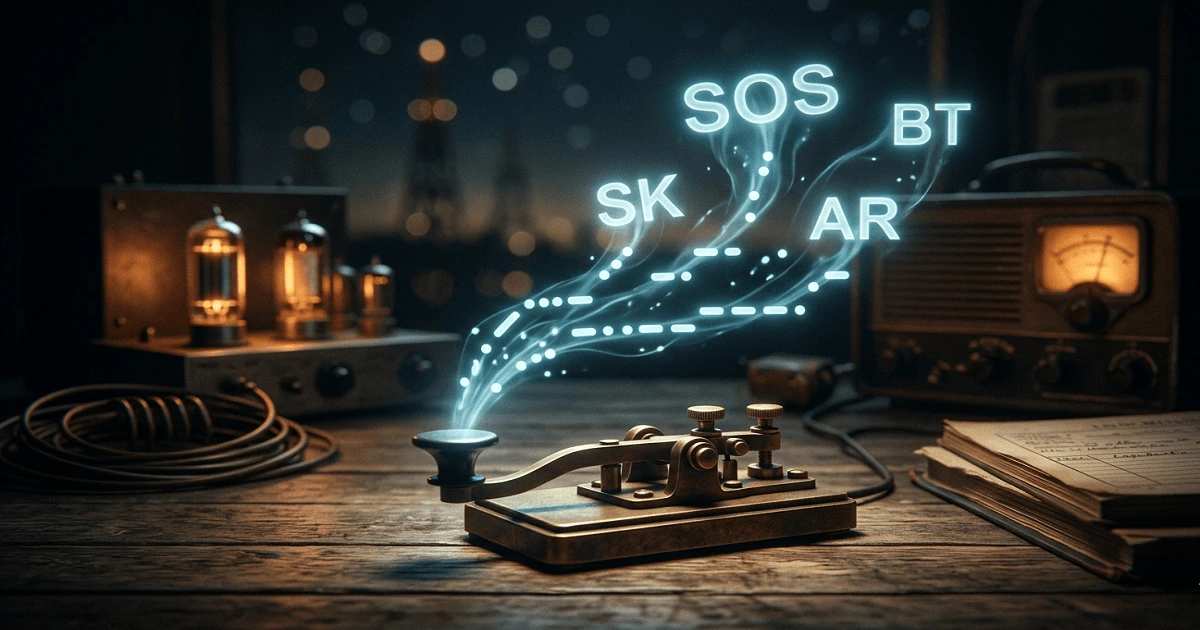
SK - End of contact. Sent as one unit: dit-dit-dit dah-di-dah. When you hear this, the conversation is over. The operator is signing off. It acts like a period at the end of a radio exchange.
KN - This one's sneaky. It means "go ahead, but only the station I'm talking to." In ham radio, when you say "KN" instead of just "K," you're telling everyone else to stay quiet. Specific invitation only.
AR - End of message. Not the same as SK. AR wraps up the content. The conversation might continue, but this particular message is finished. Sent as dit-dah di-dah-dit with no gap.
More Prosigns Worth Knowing
Once you've got those four, these add even more control to your sending.
BT - This is your pause button. It's a separator between thoughts, like a comma or paragraph break. Operators use it to break up long transmissions. Sent as dah-dit-dit-dit-dah, it's a double dash in sound. You can actually hear the rhythm of it when it flies past. BT is a workhorse.
AS - Stands for "wait." Sent as dit-dah dit-dit-dit. If you need a moment to catch up or find information, this buys you time.
CL - "Closing station." You're shutting down your equipment and going off the air. Different from SK, which just ends one contact.
CQ - A general call to anyone listening. "Hey, is anybody out there?" It's the original "hello world" of radio.
If you're still wrapping your head around the alphabet itself, spend time with our Morse code alphabet chart. It shows every letter's pattern clearly, which makes learning these combined signals much smoother.
Common Morse Code Abbreviations
Now for the everyday shorthand. These are abbreviations sent with normal letter spacing. They're the text slang of the telegraph world. And many of them date back over a hundred years.
The Numbers with Hidden Meanings
Some of the most famous abbreviations aren't letters at all. They're numbers.
73 - Best regards. This is the granddaddy of them all. It goes back to the early wired telegraph days and got cemented into ham radio culture early on. When you send someone 73, you're sending friendship.
88 - Love and kisses. A little warmer than 73. Often used between couples or close friends on the air.
44 - A cheerful acknowledgement. Think of it as a smiling nod.
These number codes are part of a bigger tradition. You can explore more of that history on our common words and phrases history page.
Letter-Based Abbreviations
Here's a table you'll want to bookmark. These show up constantly in Morse exchanges.
| Abbreviation | Meaning | Notes |
|---|---|---|
| TU | Thank you | Quick, polite, universal |
| PSE | Please | Saves time on a common word |
| GM | Good morning | Friendly opener |
| GA | Good afternoon or Go ahead | Context tells you which |
| GE | Good evening | Evening greeting |
| HW | Copy received correctly | "I got it" |
| R | Received or Roger | Single letter acknowledgment |
| K | Over to you | Invitation to transmit |
| QRL | Is this frequency busy? | If yes, find another |
| QRV | I'm ready | Let's do this |
| OM | Old man | Friendly term for a male operator |
| YL | Young lady | Any female operator |
| XYL | Wife | Originally "ex young lady" |
A Quick Reference Table for Prosigns
This one belongs on your screen while you practice.
| Prosign | Sound Pattern | Meaning | Sent As |
|---|---|---|---|
| SOS | ... --- ... | Distress call | One continuous unit |
| SK | ... -.- | End of contact | Merged, no gap |
| KN | -.- -. | Specific station only | Merged, no gap |
| AR | .- .-. | End of message | Merged, no gap |
| BT | -... - | Pause, separator | Merged, no gap |
| AS | .- ... | Wait | Merged, no gap |
| CL | -.-. .-.. | Closing station | Merged, no gap |
| CQ | -.-. --.- | General call | Merged, no gap |
Learning to send and receive these cleanly is one of the fastest ways to sound like a pro. Our practice page gives you a space to drill them until they feel second nature.
How to Send Prosigns Correctly
The trick to prosigns is the spacing. Or more precisely, the lack of it.
Normally when you send two letters in Morse, you leave a tiny pause between them. That pause is about the length of three dots. It's what tells the listener "new letter."
With a prosign, you kill that pause.
The letters run together. They become one gesture. Your key doesn't lift for the space. The rhythm stays unbroken.
Here's a step-by-step for getting it right.
First, know the individual letters cold. If you're still hesitating on what "S" or "K" sounds like, prosigns will trip you up. Get comfortable with the basic alphabet first. Our guide on how to learn Morse code fast walks you through a method that builds speed naturally.
Second, practice the transition. Send the first letter. As you finish its last element, go straight into the first element of the next letter without pausing. No gap. No breath. Just flow.
Third, listen for the shape. Prosigns have distinct rhythms. SK has a bouncy, closing feel. BT rolls along like a drum fill. SOS is unmistakable once your ear catches it. Training your ear matters more than your key at first.
Start with SOS. It's the most forgiving. Then move to BT and SK. Once those feel natural, the rest come faster.
Real Stories: When Knowing This Stuff Matters
A ham radio operator I know once heard a faint SOS coming through heavy static. It was a sailor on a small boat, engine dead, drifting off the coast. The operator copied the signal, relayed it to the Coast Guard, and stayed on frequency until help arrived.
He told me later that the only reason he caught it was that SOS has a rhythm nothing else matches. Even through the noise, his ear knew the sound.
Another friend keeps a small Morse reference card in her hiking pack. She's never had to use it. But she told me that knowing she could tap out a distress signal with a rock against metal if she broke her leg gives her a quiet confidence. The woods feel less lonely.
That's what this knowledge does. It sits in your back pocket, ready when you need it. And in the meantime, it's just fun to have a secret language.
Pro tip: If you're ever practicing with a flashlight, prosigns become even more important. The light doesn't allow for the same precision as a key. Shorter, tighter signals get through cleaner. Our guide on sending Morse code with a flashlight shows you how to adjust your technique for light-based signaling.
Q Codes: A Brief Nod to the Bigger Picture
You'll hear operators toss around things like QTH and QSO. Those are Q codes, a separate system of shorthand that started in maritime radio. They're not prosigns, but they live in the same toolbox.
A few quick ones worth knowing:
QTH - My location is...
QSO - A conversation or contact between stations
QRM - Man-made interference, usually other stations talking nearby
QSB - Fading signal
Q codes work a little differently. Some are questions when sent with a question mark. Some are statements. But that's a topic for another day.
For now, just know that prosigns, abbreviations, and Q codes all work together. They form a layered system of shortcuts that make Morse communication fast, precise, and surprisingly expressive.
How to Memorize These Without Losing Your Mind
You don't need to memorize everything at once. Honestly, you shouldn't even try.
Start with five. Pick the ones most relevant to what you're actually doing.
If you're learning for emergency preparedness, SOS first. Then BT and AR so you can format a clean message. Then SK so you know how to end.
If you're getting into ham radio, start with CQ, 73, and K. Those open the door to your first conversation.
Then add one new one each week. Just one. Every time you sit down to practice, work the new one into your drills. Send it at the start of a session. Send it at the end. Listen to it in recordings.
Within a month, you'll have a working vocabulary that covers most real situations.
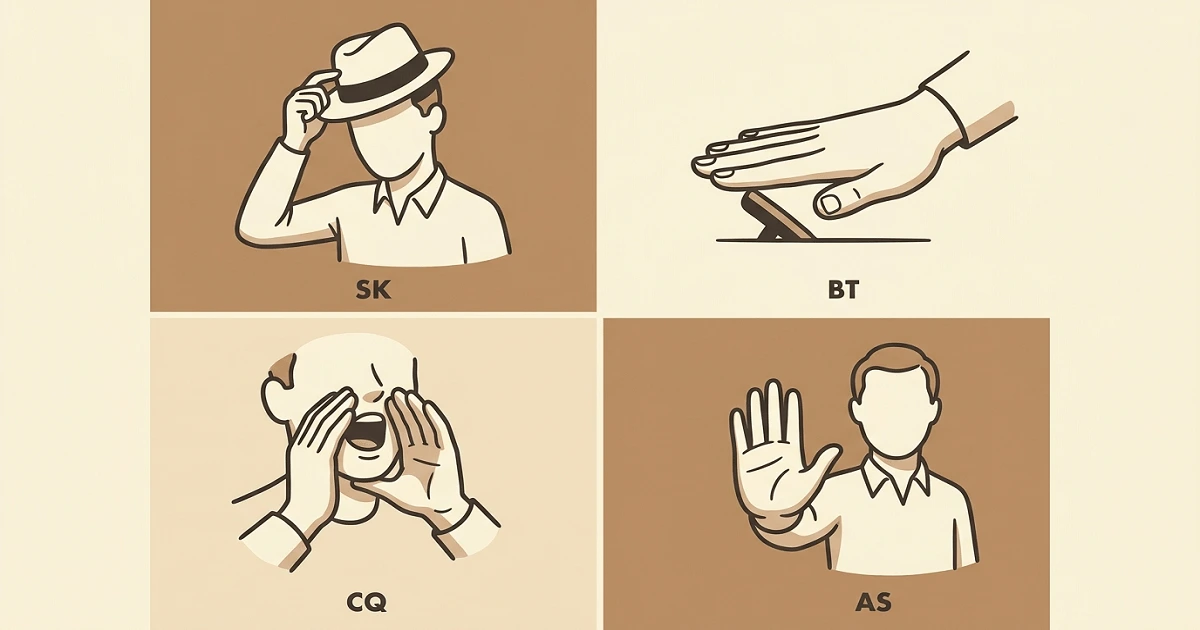
Memory trick: Associate each prosign with a physical gesture. For SK, imagine tipping a hat goodbye. For BT, picture tapping the brakes in a car. For CQ, see yourself cupping your hands around your mouth to yell. The body remembers what the brain forgets.
List of Common Morse Code Words & Translations
If you're building your vocabulary, these articles live right here on the site and make great next steps. Each one digs into a specific word or phrase with its full translation and story.
Help in Morse Code - The signal that calls for assistance
Love in Morse Code - Romantic, timeless, surprisingly simple
I Love You in Morse Code - Three words, one beautiful pattern
The broader history of how these phrases developed is worth your time too. Check out the common words and phrases history page for the backstory behind the signals we take for granted.
And if you're wondering how all this fits into the world today, our modern uses of Morse code article will surprise you. Morse hasn't gone anywhere. It's just changed shape.
Frequently Asked Questions
Your Next Step
You've got the list. You know the difference between a prosign and an abbreviation. You've seen how these shortcuts turn Morse code from a spelling exercise into a fluid language.
Now it's time to put them into practice.
Pick one prosign. Just one. SOS if you want the iconic one. SK if you want something practical. Go to our Morse code practice page and spend ten minutes drilling it. Send it until your hand knows the shape before your brain does.
Then pick an abbreviation. 73 is a good choice. Send it five times every morning as a warmup. Within a week, it'll feel like breathing.
Morse code abbreviations and prosigns are your ticket to faster, more natural communication. They're the secret handshake of a global community that's been tapping out friendship and meaning for nearly two centuries.
Go ahead. Start tapping.
Visit our Morse code translator anytime you need to check a signal or translate text to morse or back quickly. The translator will help you see the patterns in actions and words, making it easier to remember and use them in real conversations. You can convert any message, listen to the sound, see the signal pattern, and share it with your friends. It's the perfect companion as you dive into the world of Morse code prosins and abbreviations.