No in Morse Code: How to Send It with Sound, Light, and Tapping


Imagine you're in the middle of a silent conversation. Someone taps a question against the wall. You need to answer. But you can't speak. You can barely move.
What's the simplest, clearest thing to say? No.
And in Morse code, “no” has a beautiful, rhythmic shape. One sharp pause, then three long beats. Let's learn it together.
Quick Answer
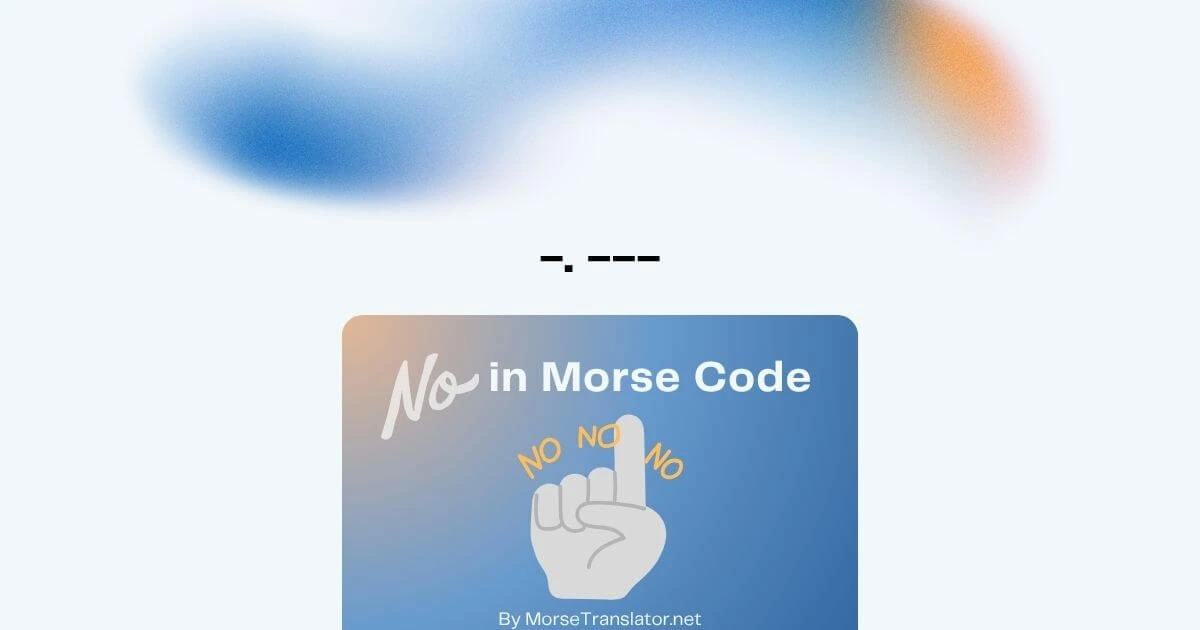
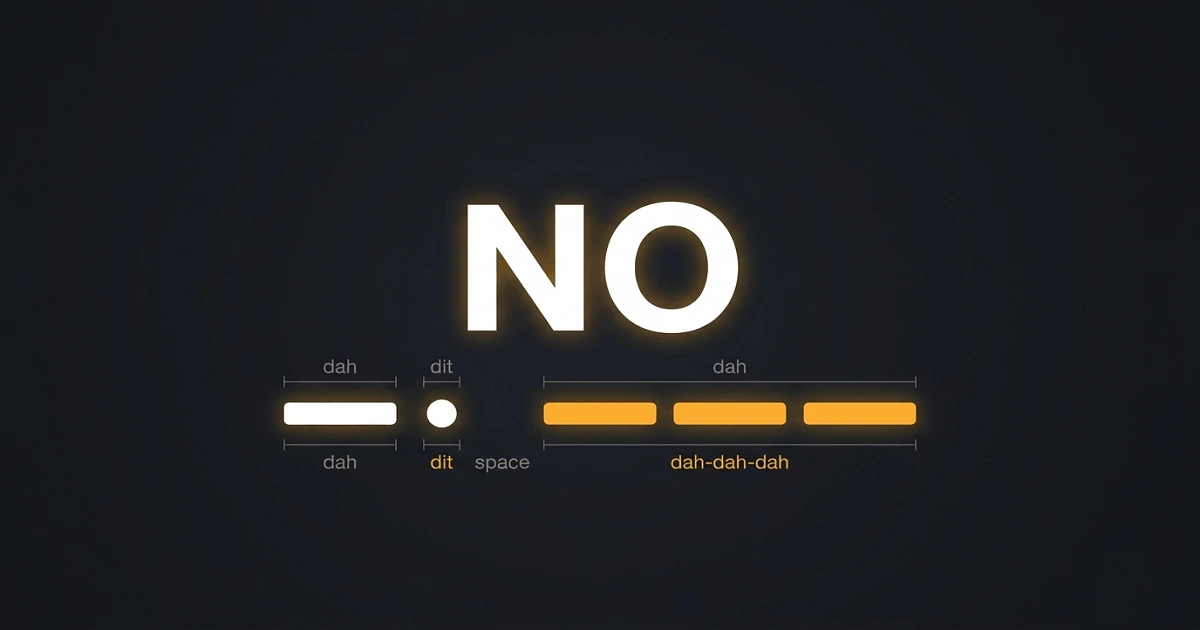
-. ---
That's “N” (-.) followed by a letter space, then “O” (---).
What “No” Looks and Sounds Like
In Morse code, every letter has its own pattern of dots (short signals) and dashes (long signals). The word no is just two letters:
| Letter | Morse Code | Sound Pattern (dit/dah) | Memory Trick |
|---|---|---|---|
| N | -. | dah-dit | Think “Naughty” – a long scold then a short tap. |
| O | --- | dah-dah-dah | “Orange” has three syllables? Just picture three long strokes – like drawing a big O. |
So when you string them together, no becomes: -. ---
Between the N and the O, you leave a small pause – about the length of one dot. That pause is what separates letters.
How to Pronounce “No” in Morse Code
Say it aloud: “dah-dit dah-dah-dah”.
The timing unit is one dot length (about 120 milliseconds at a medium pace). A dash is three dots of sound, and the space between letters is also three dots of silence.
- N = one dash + one dot: 3 units + 1 unit (with 1 unit silence between).
- Letter pause = 3 units of silence (after the N).
- O = three dashes: 3+1+3+1+3 units.
Hear it yourself:
Why Learn “No” in Morse Code?
You might think “yes” is more positive, more useful. But “no” protects you. It sets boundaries. It answers clearly.
In an emergency, a quick “no” can stop someone from making a dangerous move. In a quiet library, tapping “no” on a desk can save a whispered argument. And for ham radio operators, sending “NO” is faster than spelling out “negative.”
Plus, learning “no” teaches you two very different rhythms: the short-sharp N and the rolling O. Once you know these, you're halfway to “on,” “off,” “now,” and dozens of other words.
Where You'll Use “No” in Morse Code
- Emergency signaling – A flashlight or whistle can send “NO” to refuse a risky action.
- Ham radio (amateur radio) – Quick exchanges during contests or net operations.
- Silent tapping – On a desk, wall, or another person's arm (e.g., under a blanket).
- Accessibility – People with limited speech or mobility use Morse code with assistive switches.
- Everyday fun – Blink “no” with your phone's flashlight across a dark room.
How to Send “No” – Step by Step
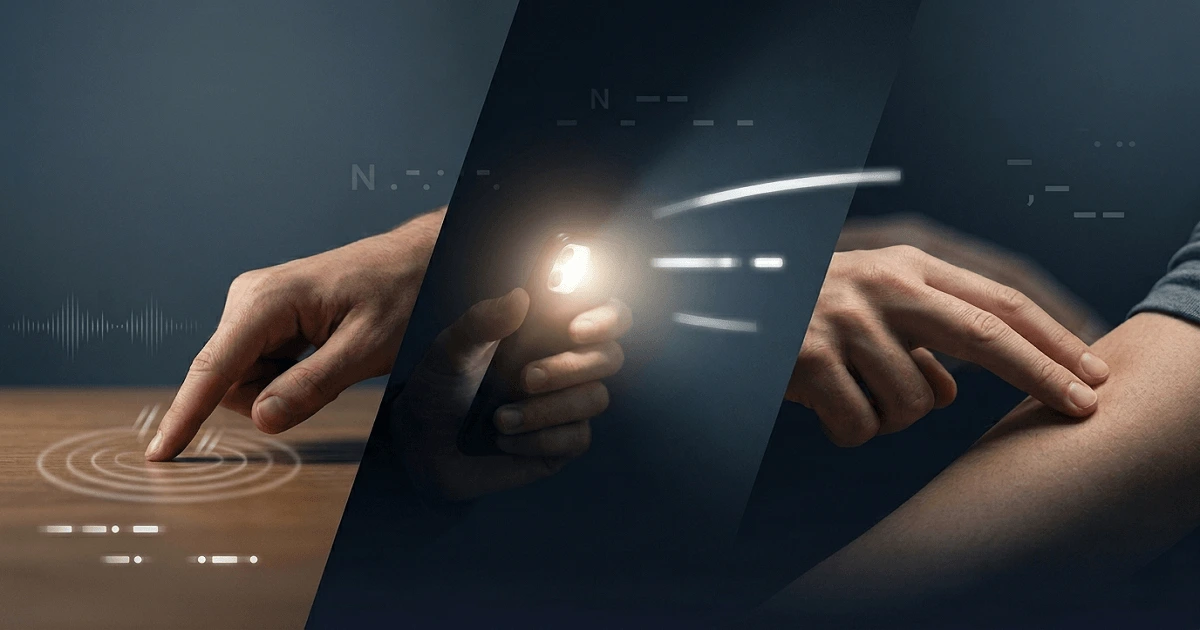
You can send Morse code three main ways: sound, light, or touch. Let's break down each one for the word “no.”
1. With Sound (beeps or taps)
- N: One long beep, then a short beep. (dah-dit)
- Pause: Wait one short beep-length of silence.
- O: Three long beeps. (dah-dah-dah)
Practice saying it out loud: “Daa-dit. Daa-daa-daa.” Speed up slowly. Soon it'll feel like a heartbeat with a skip.
2. With Light (flashlight or screen)
Perfect for nighttime signaling. Use your phone's flashlight or a bike light.
- Hold the button for a long flash (dash) → about 3 seconds.
- Tap quickly for a short flash (dot) → about 1 second.
- For N: Long, short.
- Pause (off) for 1 second.
- For O: Long, long, long.
If you want to practice visually, our flashlight guide has a real-time demo.
3. With Touch (tapping on someone's arm or a surface)
This is how prisoners of war have communicated for decades. A long tap = dash. A short tap = dot.
Tap once long, once short for N. Pause. Then three long taps for O. Your partner will feel the difference easily – dashes feel heavier.
Common Mistakes (And How to Avoid Them)
- Wrong spacing: Sending “-.---” (no pause) becomes “N” followed by “O” without a letter space – it sounds like one long jumble. Always insert a full letter gap (3 dots of silence).
- Confusing N with K: “K” is “-.-” (dah-dit-dah). Beginners often add an extra dash at the end. N is just “-.” (dah-dit) and then stop.
- Using “N” alone as “no”: In some fast exchanges, a single “N” can mean “no”, but it's ambiguous. For absolute clarity, always send the two-letter “NO”.
- Rushing the O: O needs three full dashes, not two or two-and-a-half. Count them: dah-dah-dah.
Variations: When “N” Alone Is Enough (and When It's Not)
In casual ham radio conversations, operators sometimes send a single N (-.) as shorthand for “no” or “negative”. This saves time, especially during contests or when bandwidth is tight.
However, N is also the first letter of many words (north, night, never). If there's any chance of confusion – for example, during an emergency or a formal exchange – use the full NO (-. ---). The extra two symbols remove all doubt.
Pro tip: If someone sends you “N” and you're unsure, reply with “NO?” (question format) to ask for confirmation. The standard query for repetition is “IMI” (.. -- ..), but a simple “?” (..--..) works too.
Practice Drills for “No” (With Speed Targets)
Start slow, then build up to conversational speeds (15–20 words per minute). Use a stopwatch or a metronome app to keep time.
Beginner Drill (5–10 WPM)
- Say “dah-dit” (N) 10 times in a row, with a 1-second pause between each.
- Say “dah-dah-dah” (O) 10 times, same pause.
- Alternate: N, pause, O, pause – 15 repetitions.
- Tap the full “NO” (with correct spacing) on your leg for 2 minutes.
Intermediate Drill (15–20 WPM)
- Send “NO” by key or flashlight 20 times, aiming for consistent 3-unit dashes.
- Copy random two-letter words from a practice app, and always write “NO” when you hear it.
- Create a sentence: “NO, I DO NOT NEED HELP” – send the whole thing at 15 WPM.
- Increase speed by 2 WPM each day until you reach 20 WPM cleanly.
Real-Life Story: The “No” That Saved a Conversation
A few years ago, a father and daughter were hiking. She had a broken ankle. No cell service. He knew Morse code from his Navy days.
She asked (by blinking a light) if he should go get help alone. He blinked back: -. ---. No. He wasn't leaving her.
That single word gave her the strength to wait. They were rescued together three hours later. “No” wasn't negative. It was loyalty.
Stories like that remind us: Morse code isn't just a museum piece. It's still saving people, one short word at a time.
Memory Tricks for “No” (That Actually Stick)
Morse code is easier when you attach a phrase to each letter. Here's what works for “no”:
- N = “naughty” – sounds like “nah-tee” – the “nah” is long (dah), the “tee” is short (dit).
- O = “orange octopus” – say it slowly: “or-ange-oc-to-pus” – each syllable gets a long sound? Simpler: just think of three taps on an orange. Three dashes.
- Or combine them: “No orange today” – the rhythm of that sentence matches the dah-dit pause dah-dah-dah.
Pro tip: Write -. --- on a sticky note and put it on your fridge. Every time you see it, tap your finger twice. You'll learn without trying.
Fun Fact:
There's no single prosign (special shorthand) for “no” in official Morse code. Unlike “OK” (which is .-.-) or “SOS” (...---...), you have to send the two letters separately. That means “no” takes five symbols – still faster than “negative” (which would be -. . --. .- - .. ...- . – a mouthful!).
How to Practice “No” Until It's Automatic
Here's a 5-minute drill. Do it once a day for a week.
- Say “dah-dit, dah-dah-dah” out loud – 10 times.
- Tap it on your thigh with your finger – 10 times.
- Close your eyes and imagine the light pattern (long-short, pause, long-long-long) – 5 times.
- Open your practice page and type random words. When you see “no” in the answer, don't look – just tap it.
You'll be surprised how fast it locks in. Your fingers will remember before your brain does.
Similar Short Words to Learn Next
| Word | Morse Code |
|---|---|
| Yes | -.-- --- ... |
| OK | --- -.- |
| Help | .... . .-.. .--. |
| Stop | ... - --- .--. |
Frequently Asked Questions
Standards and References
The Morse code patterns used on this page follow the International Morse Code standard defined by the International Telecommunication Union (ITU) – specifically ITU-R M.1677-1.
For historical and operational best practices, the American Radio Relay League (ARRL) provides extensive resources for ham radio operators, including the use of prosigns and shorthand like “N” for “no”.
If you want to verify any code or explore official documents, consult the ITU's International Morse Code Recommendation or the US Coast Guard navigation center (which still teaches Morse for emergency signaling).
Want the full alphabet? Check our Alphabet Chart or jump to the free online Morse translator to convert any sentence into dots and dashes instantly.
"No" is a complete sentence. In any language. In any code.
So go ahead – tap it, flash it, beep it. Own that tiny, powerful word.
You're now officially one word closer to fluent Morse.