Morse Code Blinking: How to Communicate With Your Eyes


The pilot who blinked a secret message on live TV
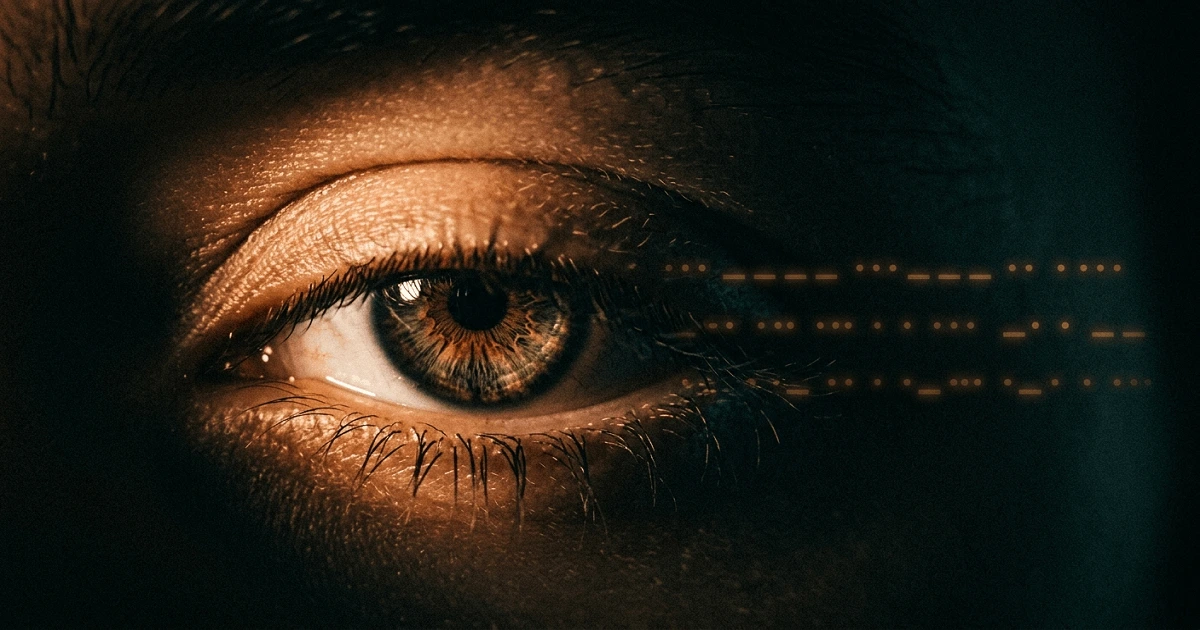
In 1966, a US Navy pilot named Jeremiah Denton sat in front of a Japanese television camera and told his North Vietnamese captors' audience that he was being treated well. His mouth said that. His eyes said something else entirely.
He blinked the word TORTURE in Morse code, slowly and deliberately, right there in the propaganda interview, and the US Office of Naval Intelligence picked it up. Fifteen blinks. Seven letters. First confirmation that American POWs were being tortured.
That's the famous example, but the mechanics behind it. How blinking actually maps to Morse code, how fast you have to go, what 3 blinks means? almost nobody explains. So here's the full breakdown.
How blinking maps to dots and dashes
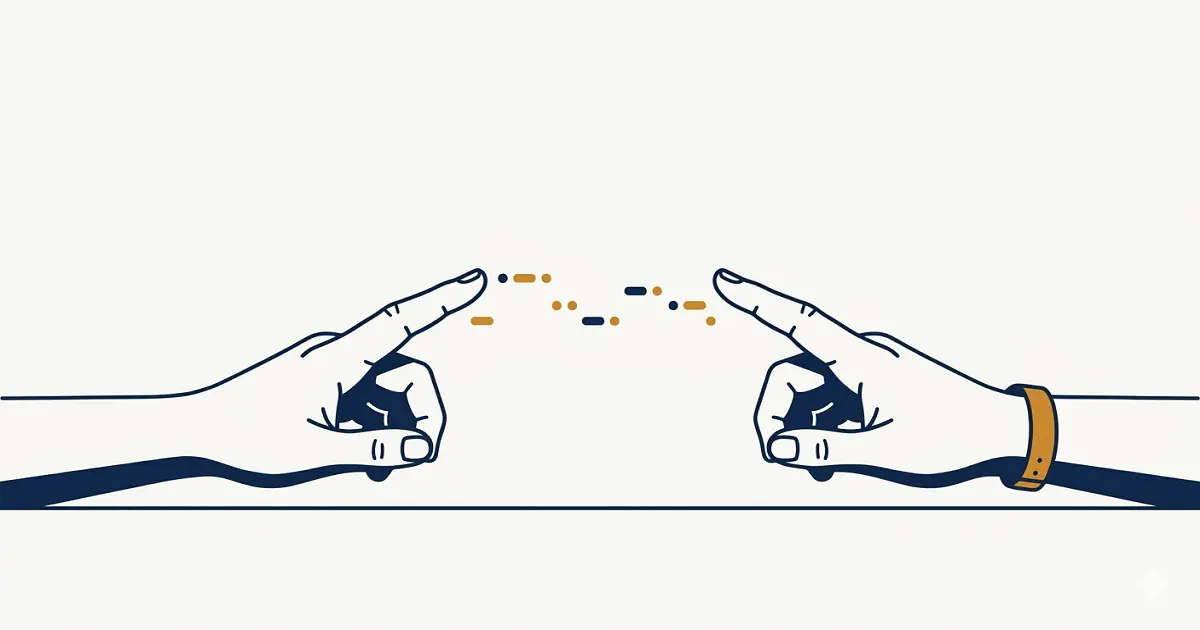
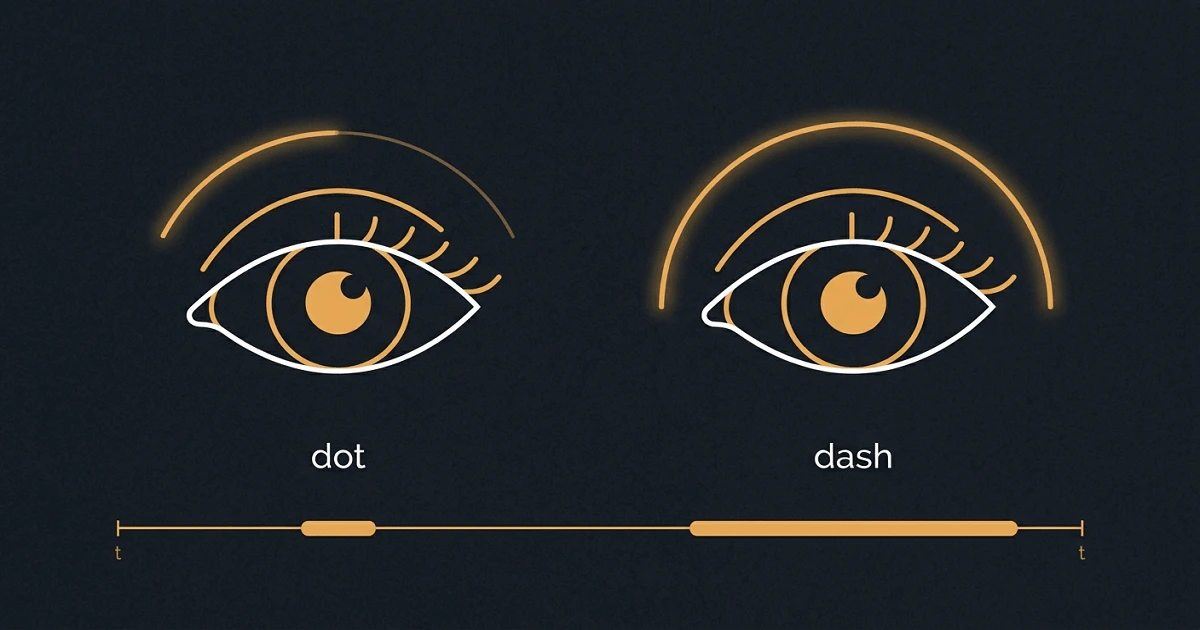
Morse code has two signals: dots (short) and dashes (long). When you blink, your eyelids become the transmitter.
Short blink = dot. Long blink = dash.
The standard ratio is 1:3. A dash lasts three times as long as a dot. In practice, most people find it easier to anchor on a mental rhythm: pick a "unit" duration (say, 200ms for a dot) and hold each dash for around 600ms. The actual timing doesn't matter much as long as it's consistent. A receiver watching you will calibrate to your pace.
Eyes open = the space between signals. And here's where it gets slightly more involved, because Morse has three different types of spacing:
- One unit gap between dots/dashes within the same letter
- Three unit gap between letters
- Seven unit gap between words
In practice, you don't need to count milliseconds. Denton didn't. You need the receiver to be watching carefully and know Morse code. Without that, none of it works. This matters mostly in emergencies, not casual conversation. You can review the full spacing rules in our guide to Morse code alphabet and spacing.
How to blink in Morse code
Step 1: Learn the letters you need first
Don't try to blink the full alphabet on the first attempt. If your goal is emergency signaling, focus on SOS (more on that below). If you want to communicate something specific, write it out in Morse notation first and practice until the pattern is in muscle memory. The Morse code alphabet chart is a good place to start.
Step 2: Set a tempo and stick to it
Pick a comfortable base speed before you start. Too fast and you lose the distinction between dots and dashes. Too slow and the receiver loses the thread. Denton's interview runs about 30 seconds for seven letters, roughly 4–5 seconds per letter. That's slow by radio standards, but totally readable to a trained eye.
Step 3: Exaggerate the contrast
A quick natural blink vs. a slow deliberate blink is harder to read than you'd expect, especially if someone is watching from a screen or across a room. Make your short blinks sharp and your long blinks obvious. Hold that eye closure for a clear beat.
Step 4: Pause between letters
This is where most beginners fail. The gap between letters needs to be noticeably longer than the gap between signals within a letter. If you rush from one letter to the next, the whole thing blurs together. Count in your head or use a mental anchor: "one elephant" between letters, "one, two, three elephants" between words.
Step 5: Have a receiver who knows what they're watching
Obvious, maybe, but worth saying: blinking Morse code at someone who doesn't know Morse is just blinking. The system only works with a shared code and an attentive receiver. If you want to practice the code itself first, our Morse code practice tool can help you get the patterns down before you try them with your eyes.
What does 3 blinks mean in Morse code?
Three short blinks is the letter S in Morse code: dot dot dot (· · ·).
If someone sends three short blinks, three long blinks, and three short blinks, that's SOS — the international distress signal. Nine blinks total. The full SOS pattern is:
· · · — — — · · ·
Three short, three long, three short.
A common misunderstanding: SOS is not three blinks. Three blinks alone is just S. You need all nine, in the right order, with the timing distinguishing short from long.
The three-blink "S" does show up in SOS, so if someone seems distressed and blinks in short bursts of three, it's worth paying attention. You can read the full history of the signal in our article on the SOS distress signal.
Can you actually blink fast enough?
Yes, with some caveats.
A natural, involuntary blink takes about 150–400ms. Voluntary blinks you can control much more precisely than that. The issue isn't speed; it's consistency. Holding a deliberate eye closure for 600ms and then doing a 200ms blink right after takes practice, but it's well within normal muscle control.
Denton's 15 blinks across roughly 30 seconds works out to about 2 blinks per second. Even accounting for pauses between letters, that's not fast. It's roughly the pace of someone tapping a key slowly on a radio.
You won't be transmitting at 20 words per minute. That's fine. Emergency communication doesn't need speed. It needs clarity.
The Jeremiah Denton story
July 1965: Denton was piloting an A-6A Intruder on a bombing mission over North Vietnam when one of his own Mark 82 bombs detonated too early. He ejected and was captured near Thanh Hoa. He'd spend almost eight years as a prisoner of war, four of them in solitary confinement.
In May 1966, his captors forced him into a televised interview with a Japanese correspondent. The script was prepared. Denton was told what to say. He told the cameras he was receiving adequate food, clothing, and medical care.
While he talked, he blinked. Slowly, with visible effort, as if the lights were bothering him.
T-O-R-T-U-R-E.
The US Office of Naval Intelligence was watching. They decoded it. It was, as his Navy Cross citation later noted, the first confirmation American POWs were being tortured in North Vietnam. When the North Vietnamese figured out what he'd done, they subjected him to another round of it.
Denton was released in February 1973 during Operation Homecoming. He later became a US Senator from Alabama. He died in 2014. His story sits alongside the broader history of Morse code as one of the more remarkable examples of what the system can do in extreme conditions.
Where blinking Morse code actually gets used
Medical communication: People with locked-in syndrome (a condition where the brain is intact but voluntary movement is almost entirely lost) sometimes retain control of eye muscles. Jean-Dominique Bauby, after his 1995 stroke, dictated his entire memoir The Diving Bell and the Butterfly by blinking to indicate letters. Blinking-based communication has been adapted into assistive technology for patients who can't speak or move.
Emergency signaling: If you're injured, restrained, or in a situation where speech would be dangerous, eye-based communication to a trained rescuer is possible. The Morse code signal for help is worth knowing for exactly this reason.
Covert communication: The Denton case is the most documented, but not unique. Intelligence and military contexts have used blink-based Morse for situations where audio and written signals are impossible. It's also listed among the modern uses of Morse code that people still find relevant today.
How to read Morse code blinking
Reading someone else's blinks is harder than sending. Your eye has to catch both the duration of each blink and the gaps between them, in real time, without losing your place in the letter.
Count aloud in your head as they blink. "Short, short, long" — that's a U (· · —). Don't try to decode a whole word at once. Decode one letter at a time, hold it in working memory, then move to the next.
If possible, have a Morse reference chart nearby. Even people who know Morse code find it easier to decode visually when they can cross-check. Our guide to learning Morse code fast covers the memory techniques that make decoding quicker.
Recording a video helps too. Denton's interview has been played back at reduced speed, which is how people confirmed the exact sequence of letters. If you have access to footage, slow it down.
One genuine difficulty: distinguishing a deliberate long blink from a natural blink that ran slightly long. Denton reportedly made his long blinks very pronounced to avoid exactly this ambiguity. When sending, err toward overemphasizing the difference.