How to Tap Morse Code on Hard Surfaces


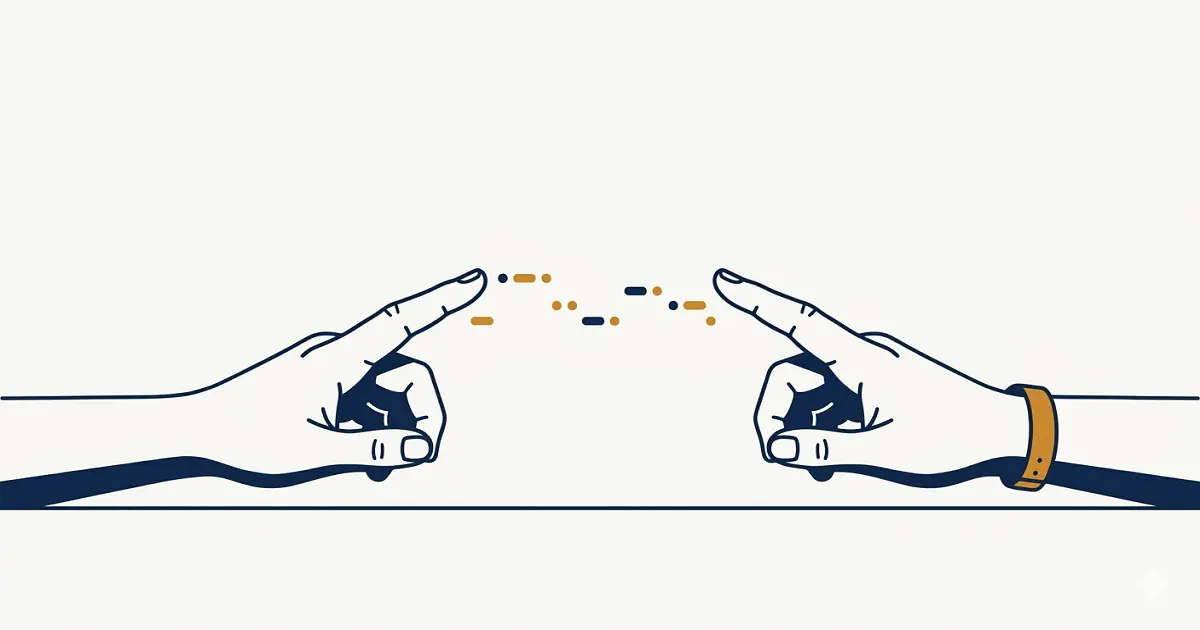
Most people trying to click out Morse code on a tabletop fail immediately. They knock blindly. They think Morse code works like a musical beat or a movie secret password.
It isn't about rhythm patterns. It's about duration.
A brief slap or click is a dot. A held, dragging contact is a dash. If your finger leaves the surface at the exact same speed after every single hit, you aren't sending messages. You're just making noise. The gap between your letters matters just as much as the taps. If you run them together, an E (one dot) and a T (one dash) become completely unreadable.
This down-to-earth breakdown lays out the exact physical habits you need to drop the noise, fix your spacing, and clear up why concrete walls and pipes destroy the message anyway.
The Physics of the Spacing Ratio
Morse operates on a strict math scale. Everything scales up from the single dot:
- Dashes last three times longer than dots.
- Inner letter components take a single dot-length break.
- Full letters are separated by three units of dead silence.
- Words need seven units of space.
Speed doesn't matter. You can tap out two words a minute or twenty. Still, you have to keep the proportions perfect.
Beginners always butcher the silence. They panic and rush into the next letter block. If you send three rapid dots for S, then immediately hit the next sequence without dropping three full counts of quiet space, you didn't send a letter. You just made an open-ended mess. Try counting out loud while practicing. Say "one" for dots, and a dragged-out "one, two, three" for dashes. It feels incredibly slow at first. Do it anyway until your fingers take over.
Fingernails, Knuckles, and Contact Mechanics
Your bare fingertip is soft. It absorbs sound, rounds off the sharp edges of your clicks, and makes speed work sloppy. Use your fingernail or a solid knuckle instead. You want a hard, metallic bite against the surface so the receiver can pinpoint when the sound starts and cuts off.
Fingernails give you the cleanest acoustic snap. If you have to keep your hands hidden or free, stamping your heel on a floorboard works too, though you lose fine muscle control. A heavy pencil tapped flat against wood gives a loud, sharp snap that carries across a full room.
The hardest part to learn is the clean lift. When you finish a dash, snap your hand back up instantly. If your finger lingers or slides, the acoustic ring stretches out. That turns your careful dots into accidental dashes, garbling the code.
The Anatomy of an SOS Signal
The universal distress call relies on basic symmetry:
S = · · ·
O = — — —
S = · · ·
SOS TIming (1 unit = 1 dot)
SOS audio file
Ratios: dot = 100ms, dash = 300ms, letter gap = 300ms
That makes nine total strikes. The rapid-slow-rapid shift stands out so cleanly that someone listening can spot it without tracking every count.
In real emergencies, skip the gaps between the letters entirely. Run the whole thing together as a single continuous block of nine signals. It makes the transmission tighter and easier to pull off when your hands are shaking or cold.
Ear Training and Real-Time Decoding
Catching incoming code is twice as hard as sending it. When your fingers tap, you know what's coming next. When you listen, you are stuck tracking unfamiliar gaps and clicks simultaneously.
Do not translate single dots or dashes one by one. You will run out of working memory by the third letter. Listen for the overall weight of the word block instead. An S sounds like a sharp, rattling triplet. An O feels heavy and dragged out. Jot down each letter on paper the second you recognize its outline. If you try to hold a whole five-letter word in your head while guessing the timing, you'll drop the thread.
Systems Comparison: Morse vs. Tap Code
| Property | Morse Tapping | Prison Tap Code |
|---|---|---|
| Signal Types | Variable (dots and long dashes) | Uniform (identical knocks) |
| Core Metric | Duration of contact | Total count of impacts |
| Solid Barriers | Fails (echoes ruin timing) | Succeeds (easy to count through walls) |
| Learning Curve | Steep (requires muscle memory) | Simple (uses a basic 5x5 grid) |
Why Prison Pipes Ruin True Morse
Hollywood loves the pipe-tapping cliché. A prisoner bangs a pipe, a cellmate down the block nods along, decoding the clicks. In the real world, this physics breaks down completely.
Thick concrete walls and iron plumbing warp sound waves. They create messy echoes and muddy reverb. By the time a click bounces through twenty yards of metal piping, a 100ms dot and a 300ms dash flatten out completely. They end up sounding identical. The physical medium eats the duration information Morse depends on.
Vietnam POWs used tap code instead. It has nothing to do with Morse. It uses a five-by-five grid of letters where every character turns into two simple numbers: row first, then column. To send an H, you locate it on the grid and hit twice for row two, pause, then hit three times for column three.
The receiver just counts the knocks. The duration of the hit means nothing. That is why it survives wall echoes perfectly. Morse tapping requires a direct line of sight or a clear, open air path where the acoustic snap doesn't turn into a smeared echo. You can look at historical records on distress signals to see how these adjustments played out in old military camps.
Practical Scenarios for Surface Tapping
If you are trapped in a collapsed space or injured after a bad fall, slapping an explicit SOS on a floorboard or stone block can guide rescuers right to you. It takes minimal strength but carries far better than yelling. Check out our summary on current applications for examples.
Ham operators use the exact same hand habits. A manual straight telegraph key is just a spring-loaded lever that translates raw finger-tapping into clean electrical currents.
The exact same timing framework applies to eye-blinking communication systems. People with locked-in syndrome rely on blink systems to build words. A quick blink forms a dot; holding your eyelids shut forms a dash. Morse stays alive because it maps onto almost any functional muscle group you have left.
Drills to Build Automatic Timing
Do not attempt the entire alphabet on your first afternoon. You will mix up the letters and quit. Start with just two characters: E (one dot) and T (one dash).
Tap them back and forth: E, T, E, T. Focus on making the physical contrast between them huge. Once that feel gets locked into your hand, add I (two dots) and M (two dashes). Now you have enough vocabulary to build basic words like ME, IT, or TIE. Practicing real words builds coordination much faster than running random patterns.
After that, add A (dot-dash) and N (dash-dot). Review our dichotomous lookup tree to see how the code structures itself logically by adding single layers of signals. For clean audio examples before you try your own, check out our baseline translation application. You can also jump over to our dedicated interactive simulator to benchmark your precision against a steady digital clock.